"You cover an amazing amount of detail, with insider perspectives,
mixed story formats and some great charts." Paul Schoemaker, PhD,
strategic management professor.
"Few investors would bet their money on this venture today. The
story of ASML is therefore not a recipe that can be easily copied
by other high-tech start-ups. However, a lot can be learned from
looking at what happened." Gjalt Smit, first CEO of ASML.
ASML Book Blogs Series
A ten-part series of reflections and chapter notes accompanying
Lessons Learned from ASML.
Another World - Multiple Perspectives on the Same Phenomenon
Blog 10 of 10 | On the Tenth Chapter of Lessons Learned from ASML: It's a Wrap
Last week, we laid ASML's history horizontally and examined the
development of the company's business equations, four core
principles that, despite taking different forms across different
phases, continued to shape the essential nature of the
organization. This week,
Susanne
and I conclude the series in much the same way Chapter 10
concludes the book itself: by reflecting on how the story came
together, looking back on the past weeks, and considering what
these insights may mean for you as a reader.
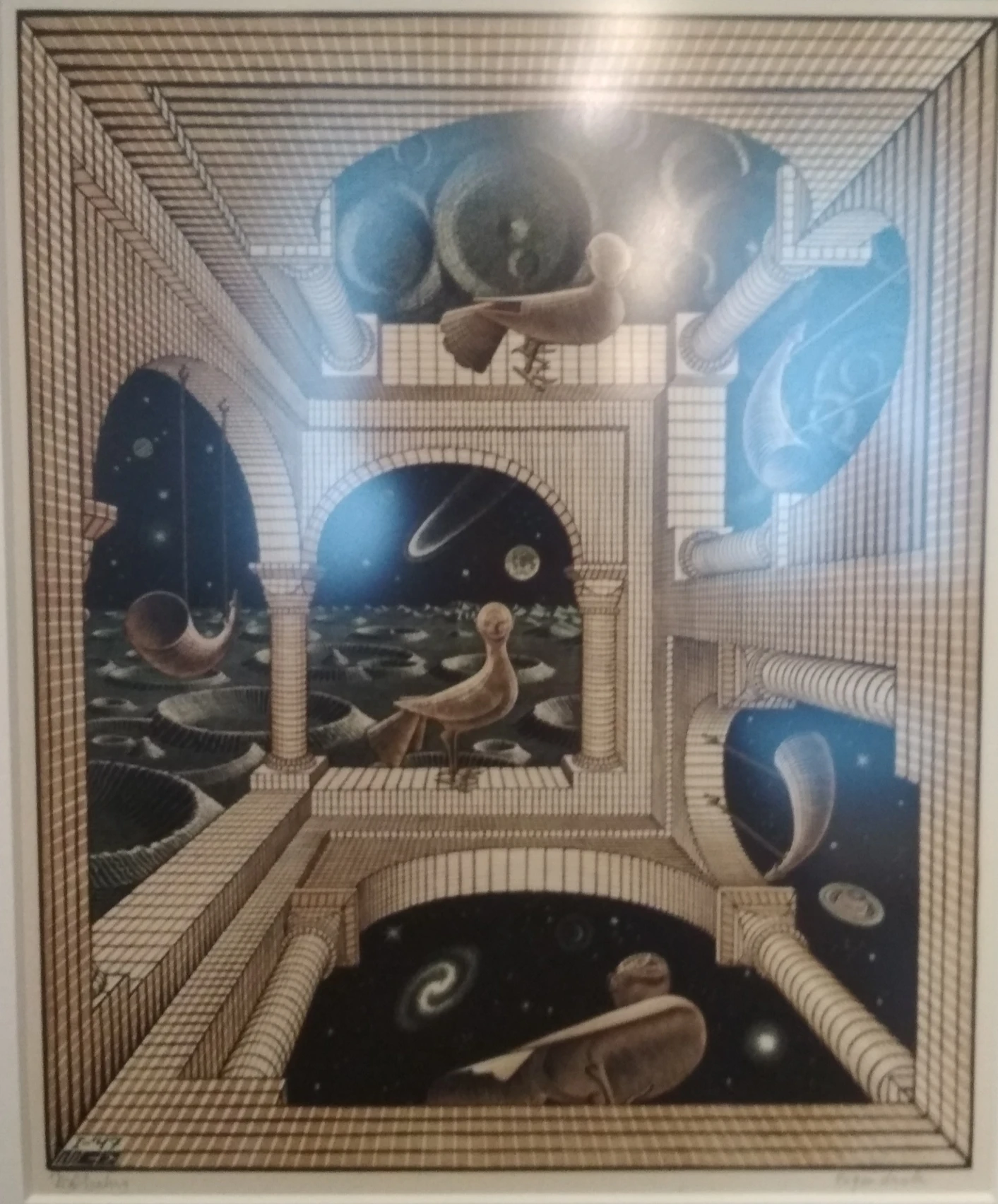
The image accompanying this blog is Another World (1947)
by M.C. Escher. We chose it for two reasons. What has always
fascinated us more than ASML's mind-boggling technology is the
organization capable of developing and commercializing such
technology while operating at the edge of what is physically
possible. The way people collaborate there, and the way the
organization collectively sustains momentum over decades, genuinely
differs from what we have encountered elsewhere. In that sense, it
truly is another world.
At the same time, throughout this book we have tried to offer
multiple perspectives, lenses, and approaches to make sense of
that world. None captures the whole picture on its own; together,
they form an interpretation we have tried to construct as
carefully and honestly as possible.
M.C. Escher (1947), Another World
The Process Behind the Book and These Blogs
This book and the accompanying blog series are built on more than
fifteen years of individual research and over ten years of joint
research. We grouped more than 1,000 documents from ASML's early
decades along a timeline: business plans, board minutes, memos,
organizational charts, annual reports. Gradually, an internal
history of more than eighty pages emerged.
In addition, between 2012 and 2021 we conducted more than thirty
in-depth interviews with current and former employees, customers,
suppliers, and competitors, often speaking with the same
individuals multiple times. Trade journals and contemporary
newspaper articles helped protect us from the temptation to read
history as though the outcome had always been inevitable. The
documents also allowed us to compare memories with what had
actually been recorded at the time, because time and success tend
to do strange things to the human mind.
Alongside this, we continuously engaged with the academic
literature since 2012, connecting the ASML story to broader
discussions on crises, capabilities, and technological
transitions.
One of the most striking aspects of the research was that when we
interviewed people independently, sometimes decades after the
events, and without them having spoken to one another, they would
often use remarkably similar formulations to describe key moments
and individuals. An audible collective memory, revealing
something about how the organization internalized its own history.
What We Tried to Show
Over the past weeks, we highlighted the different chapters in a
non-chronological order, gradually moving from the abstract
toward the concrete. Here, we briefly revisit them one final time.
Waterfall established the terrain: what ASML
does, how EUV lithography works, and why complacency is considered
taboo inside ASML, where its dominant position may never be
perceived internally as a monopoly.
In Relativity, we treated chance and luck as
serious explanatory factors in the ASML story. Chance, luck, and
serendipity are often grouped together, even though each demands a
different managerial response. We explored the notion of chance
and necessity: how do organizations respond to events that either
help or hurt them?
Belvedere examined what an extraordinarily
specific case can still teach others. Here, we attempted to
capture the theoretical patterns visible in ASML through lenses
that may also help interpret organizations in very different
contexts. That bridge must be built carefully, because contexts as
specific as ASML's resist easy generalization.
In Three Worlds, Susanne and I temporarily set
aside theory and data to present our own perspectives on working
under uncertainty: disciplined readiness on one side, and a
systemic perspective attentive to the human undercurrent on the
other.
Hand with Reflecting Sphere reversed the lens,
from ASML toward the reader. Managers, deep-tech founders,
executives, policymakers: four different seats, each with its own
context, constraints, and room for action. Whatever seat you
occupy, the question remains the same: how do you translate what
worked in Veldhoven into something meaningful in your own setting?
Drawing Hands moved the story to the level of
the semiconductor industry as a whole. We examined The Decision of
the Century surrounding the Next Generation of Lithography, and
the insight that a shared roadmap derives authority not from
technical correctness alone, but from the fact that the industry
collectively created it.
In Three Spheres II, we brought the NGL decision
back to ASML itself. We connected real options logic with a
scientific mindset, and explored the 1995 decision to internalize
the strategic question surrounding future lithography
technologies. "Do not outsource the question," as Jos Benschop
put it.
In Mobius Strip II, we placed forty years of
ASML alongside one another in five acts, from permanent financial
scarcity, through market leadership, to apparent indispensability.
A story about how apparent chaos, combined with clear role
awareness, can generate exceptionally fertile flows of knowledge
and learning.
Finally, in Magic Mirror, last week, we looked
across time itself: the four business equations that functioned as
a grammar recognizable across forty years. Deliberately designed
and imprinted into the organization, and reinforced through every
crisis.
What Do We Hope Remains?
In the final chapter of the book, we write:
"Each management book you read, this one included, is just
another piece in the puzzle, another training example for the
large language model in your own head."
What we hope is that this book becomes one of those building
blocks in your own thinking, something that helps you look more
sharply at your own organization tomorrow. Paper is patient;
without action, everything remains on the shelf. We are deeply
curious to see what movements these perspectives may ultimately
trigger.
If you still have questions following this series, the book, or
the podcast, please feel free to reach out.
The Final Week
Next week, on June 2, Lessons from ASML - Building and
Sustaining Innovativeness under Uncertainty will officially
be published by Lannoo Campus. Until then, you can pre-order a
signed copy here, Susanne and I will include a personal message.
May 21, 2026
Magic Mirror - The Transformations of an Enduring Core
Blog 9 of 10 | On the Third Chapter of Lessons Learned from ASML: Same Rules, Dynamic Game
Last week,
Susanne
and I lay that history horizontally and looked
for the underlying patterns. Which decision rules from the
earliest days carried all of those episodes? And how can an
organization remain highly innovative and adaptable while never
letting go of choices made during its very first summer?
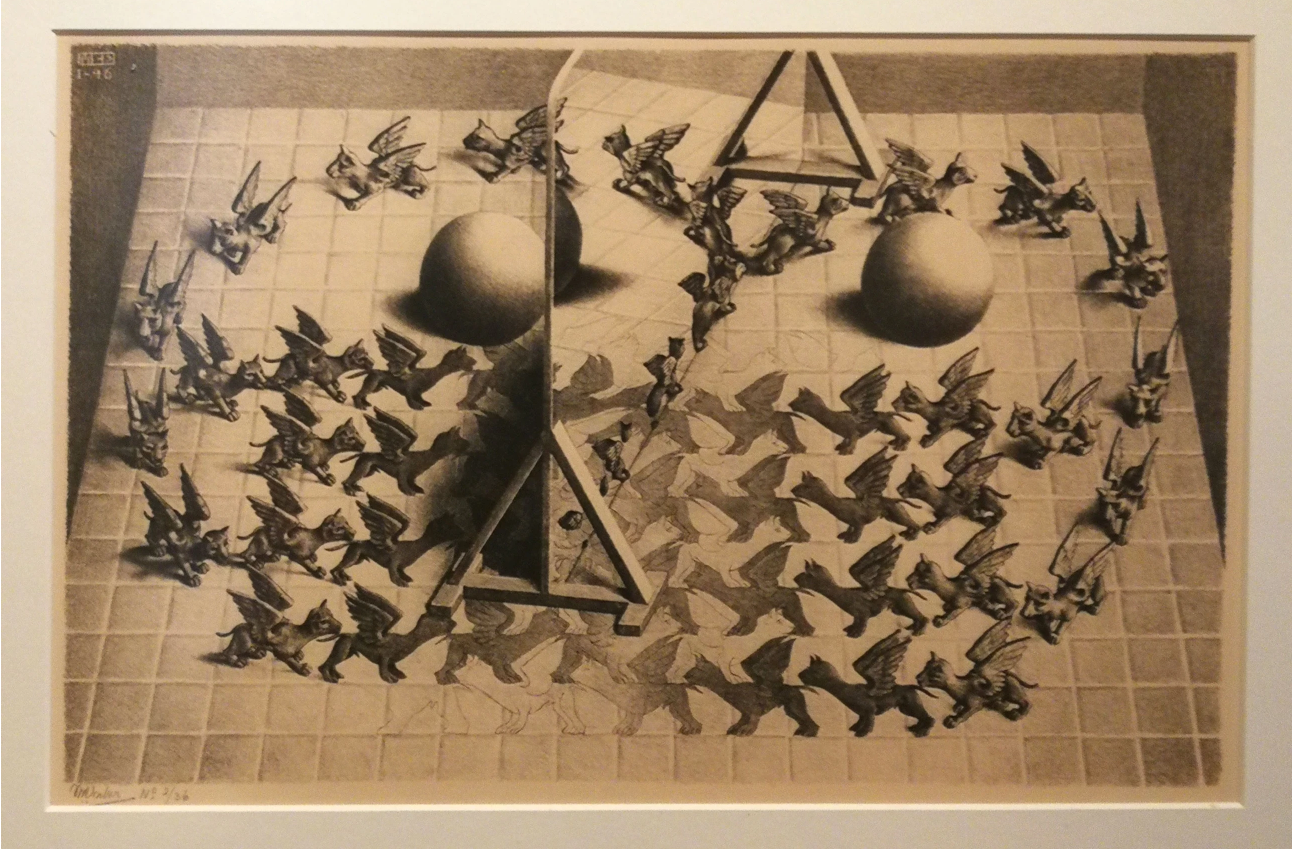
In M. C. Escher's Magic Mirror (1946), a mirror sits at
the center of a surface. A winged lion emerges from it, splits
into two streams, and marches across the plane while repeatedly
changing form along the way. What makes the creatures recognizable
through all those transformations is their shared origin: the
mirror from which they emerged. Their essence remains intact while
their forms continuously change. Chapter 3 explores how a similar
pattern emerged within ASML.
M.C. Escher (1946), Magic Mirror
The Plan of 1984
The choice that ASML's first CEO, Gjalt Smit, presented to the
supervisory board in the summer of 1984 was binary: stop, or go
for gold. There was no middle path.
Reading the business plan that the top management team wrote that
summer remains striking. It contains remarkably explicit
assumptions about how the market should be approached, how the
company wanted to organize itself internally, and which
organizational choices were considered essential. These were
concrete principles, deliberately formulated and weighted, which
were later translated into action.
Only years later, when a group of former managers around 2000
tried to document the company's history, were these retrospectively
described as business equations, as if market leadership were
something that could be solved mathematically.
From the interaction between the original business plan, those
later reflections, archival material, and interviews with key
actors, we distilled four business equations. What those four are,
how we arrived at them, and how they remained visible decades
later form the backbone of this chapter.
Strategy or Improvisation?
When speaking with people from the earliest years, forty years
later, two different versions of that summer emerge.
One comes from the promising young engineers of the time, close to
top management, but not yet major decision-makers themselves.
Among them were Frits van Hout, later CSO, and Martin van den
Brink, later CTO. Their interpretation: there was barely any
strategy. The company largely worked with whatever resources it
had, and many things later called strategic choices were in
reality products of scarcity.
Martin put it this way in our interview:
"If you have no strategy, well, for instance, what we said to
have as a strategy in the first ten years is that we are going to
be light [...] We are not going to insource supplies, we do it all
outside. And you define it today as a strategy. At the time, there
was no strategy at all; you had no money."
Only in retrospect, Martin argued, did events acquire the
appearance of a coherent plan.
The board and senior executives from those early years describe it
differently. The business plan itself, which we revisited
repeatedly during the research, lends support to their view. It is
a document that thinks remarkably carefully about the organization
it intended to build, treating the machine as only one component
of a larger system.
Both interpretations reveal something that cannot be reconciled by
simply choosing one over the other. One reflects the day-to-day
reality of surviving with too few people and too few resources.
The other reflects intention: how ideas were formulated, repeated,
and transmitted through documents, speeches, and onboarding
programs.
What organizations carry forward across generations is usually the
latter. That may explain why so much inside ASML decades later
still resembles a plan written by people who themselves felt they
were simply trying to survive.
Grammar and Formulations
The HAY consultant Thone, who supported ASML in structuring the
organization in 1985, captured the core challenge in an internal
note:
"The future is unpredictable, flexibility is indispensable. The
challenge is to balance that with a sense of direction, to be able
to clearly communicate and get a sense of control in the
organization."
How do you maintain direction in an environment that constantly
demands adaptability and improvisation?
Forty years of ASML suggest one answer. The four business
equations formed a grammar that remained remarkably stable over
time, while the sentences built from them continuously evolved.
One equation concerned maintaining an open and proactive
relationship with customers. In 1985, that meant personal
relationships between a handful of people. By 2003, the same
principle had expanded into global multidisciplinary account
teams, research consortia with institutes such as IMEC, and joint
development programs with chipmakers and their ecosystems.
The underlying structure remained recognizable. The practice
became almost unrecognizable.
For us, this is where ASML's resilience emerged: the rules
established in 1984 became a compass within which forty years of
improvisation could occur, without losing direction.
Crises Make Grammar Fluid
When can such a grammar be written, or rewritten?
In day-to-day operations, revisiting fundamental assumptions is
usually the last thing organizations do. What the literature calls
sensitive periods are rare moments when established patterns
become temporarily fluid: deep crises, technological
discontinuities, or sudden growth shocks.
ASML experienced three such periods in the years we studied: the
industry downturn immediately after its founding, the existential
crisis of 1991-1992, and the dot-com collapse of 2001.
In each case, the company could have rewritten its grammar,
adding rules, abandoning them, or replacing them altogether. What
happened instead is what the chapter explores in detail.
Looking Across Time
In Chapter 2, we followed ASML longitudinally. Chapter 3 turns
history sideways: four business equations, each traced through
three different crises.
Only through that cross-sectional perspective does it become
visible which rules actually endured, and which transformations
were necessary for them to survive.
If you study only one moment, you mostly understand that moment.
Only a sequence reveals what runs underneath them all.
Ultimately, everything returns to the chapter's central question:
how can a carefully chosen set of rules become the compass that
allows an organization to continuously reorient itself in a
turbulent world?
A question that returns in every turbulent industry, and one to
which ASML developed an answer that remains visible today.
Next week, we will conclude the series. This time, we turn the
lens toward you and me, and what, as readers, we should make of
all this.
May 13, 2026
Mobius Strip II - a Remarkably Effective Anthill
Blog 8 of 10 | On the Second Chapter of Lessons Learned from ASML
Last week, we ended with the promise to return to how ASML's
focus on one product and one business line historically emerged.
Chapter 2 provides the building blocks for that story. To keep
the whole manageable,
Susanne
and I divide forty years of ASML
into five acts. In each period, we examine the same three
elements: the context and challenge facing the organization, the
strategic choices that were made, and the outcomes that followed
from their execution. A complete company history would have
required several additional books. What Chapter 2 offers instead
is a canon: a structured selection of defining moments that
reveals the coherence behind the development of ASML's
innovativeness over time.
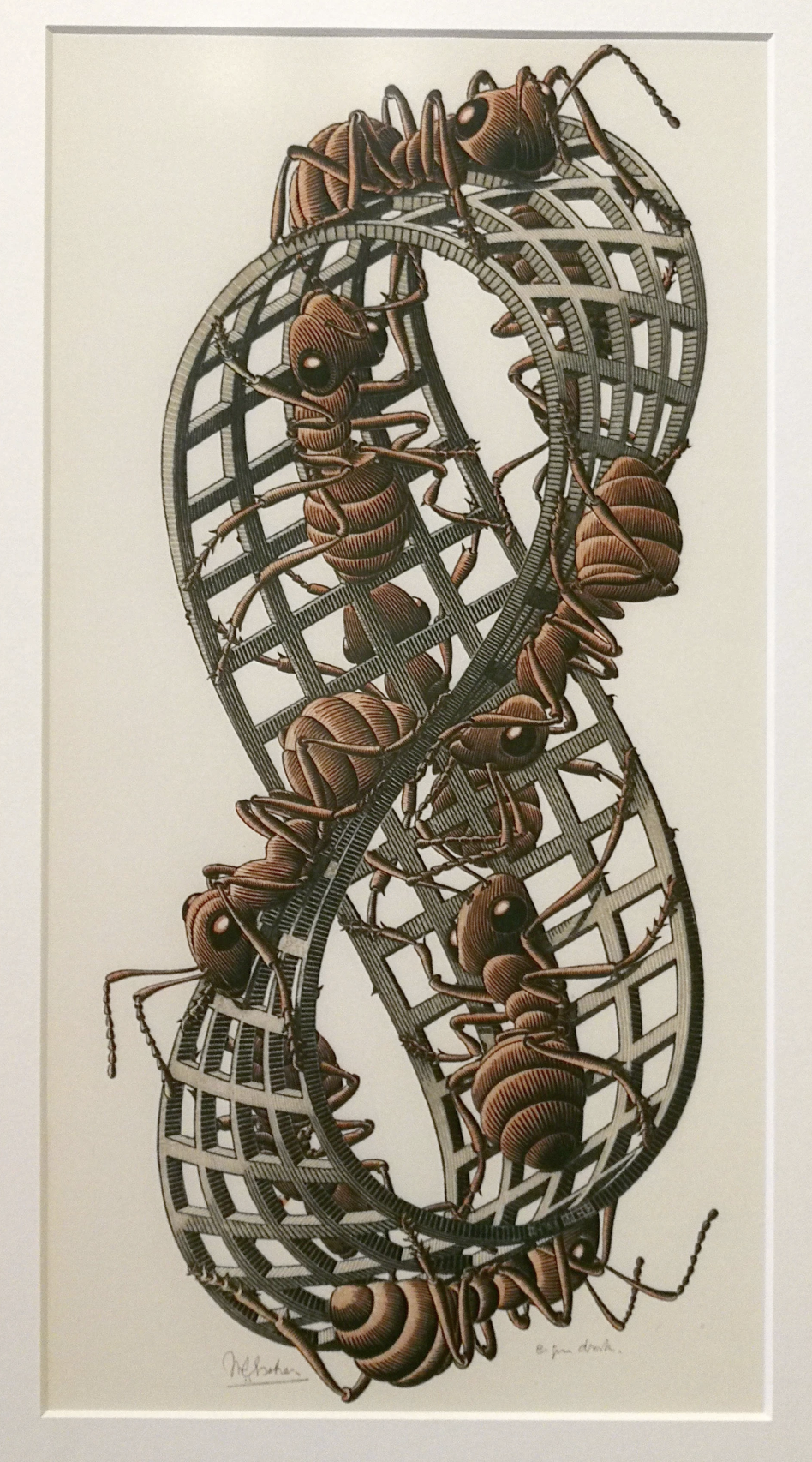
The Escher image accompanying this blog is M. C. Escher's
Mobius Strip II (1963), showing ants moving endlessly
across a Mobius strip. We chose it because of a remark by Willem
Maris, ASML's third CEO, who once described the organization as
an anthill, everyone constantly moving through one another,
chaotic at first sight, yet somehow highly effective. Fia
Loozen, for many years secretary to the board, added in an
interview that despite this idiosyncratic atmosphere, everyone
clearly understood their role and place within the whole. The
constant interaction, coordination, and informal exchanges had an
important side effect: knowledge and insights flowed continuously
through the organization.
In this chapter, we follow ASML through five phases, each with
its own obstacles and challenges, yet all part of the same
continuum.
M.C. Escher (1963), Mobius Strip II
The Broader Trajectory
ASML began as a spin-off dismissed by its own industry as a
hopeless outsider, the last among seven competitors. Employees who
joined the fragile start-up were promised that, if things failed,
they could return to Philips within four years.
Ten years later, the company was still small and frequently close
to bankruptcy, with Philips seriously considering selling the
business in 1992 for a symbolic one guilder. By the turn of the
century, ASML shared the market with only two remaining Japanese
competitors. Another decade later, it had become the only company
in the world capable of delivering the most advanced lithography
systems.
The company evolved from permanent financial scarcity to market
leadership and eventually to what appears today as near
indispensability. The transition between each phase was marked by
a significant crisis. In the chapter, each act contains one or two
episodes explored as mini-stories: a flight from San Francisco
during which the first CEO arrived at a fundamental insight after
half a bottle of wine; a last-minute rescue by a Philips board
member who convinced his own organization to finance ASML for
another nine months; or orders entering production before
contracts had even been signed. These episodes accumulate into a
larger narrative, the full story, of course, is in the book.
"The company evolved from permanent financial scarcity to market
leadership and eventually to what appears today as near
indispensability. The transition between each phase was marked by
a significant crisis."
The Philips Paradox
ASML always understood that its technology, and therefore the core
of its competitive strength, originated from Philips. The
alignment technology, the early pressure placed on Carl Zeiss AG,
the guarantees and bridging finance when conditions became
critical: these indispensable resources all came from the parent
company.
At the same time, technology alone was not enough to achieve
commercial success. For that, ASML had to develop its own model.
On the one hand, the company relied heavily on Philips; on the
other, it deliberately sought to become radically different in its
market approach. It developed a logistics system that enabled a
relatively small integrator to survive within a value chain
dominated by much larger firms. Above all, the organizational
culture needed to be different.
The chapter traces the evolution of this layered and sometimes
paradoxical parent-daughter relationship across each phase. Later
in the book, the Philips-ASML relationship becomes a case study
in its own right.
The Canon - and What Follows from It
Between the original 47 employees and the more than 44,000 of
today lie five distinct phases, each building logically upon the
previous one. The canon presented in this chapter reveals
patterns that return throughout the book's more specialized
chapters: the design of the business, the ecosystems in which
ASML operated, decision-making under uncertainty, and the
interplay between chance and necessity.
Readers working in organizations with long developmental
trajectories of their own may find in this chapter a way to
reconsider their own histories. Which early choices later proved
foundational? What did crises teach the organization that could
never have been learned otherwise? Which distinct phases can be
identified in your own organization, and in which phase are you
now? How do you build capabilities over time while preserving
strategic flexibility?
Next week: Blog 9 turns to Chapter 3, where we examine what this
sequence of crises left behind inside the company. We explore how
early decisions and actions became imprinted, and how the four
core rules of the original start-up continue to shape ASML today.
May 7, 2026
Three Spheres - Three Options, One Mirror of the Future
Blog 7 of 10 | On the Fifth Chapter of Lessons from ASML
Last week,
Susanne
and I looked at how the semiconductor industry
as a whole dealt with the collective uncertainty surrounding The
Decision of the Century for the Next Generation of Lithography
(NGL). This week, we zoom in on that same decision, but this time
from Veldhoven.
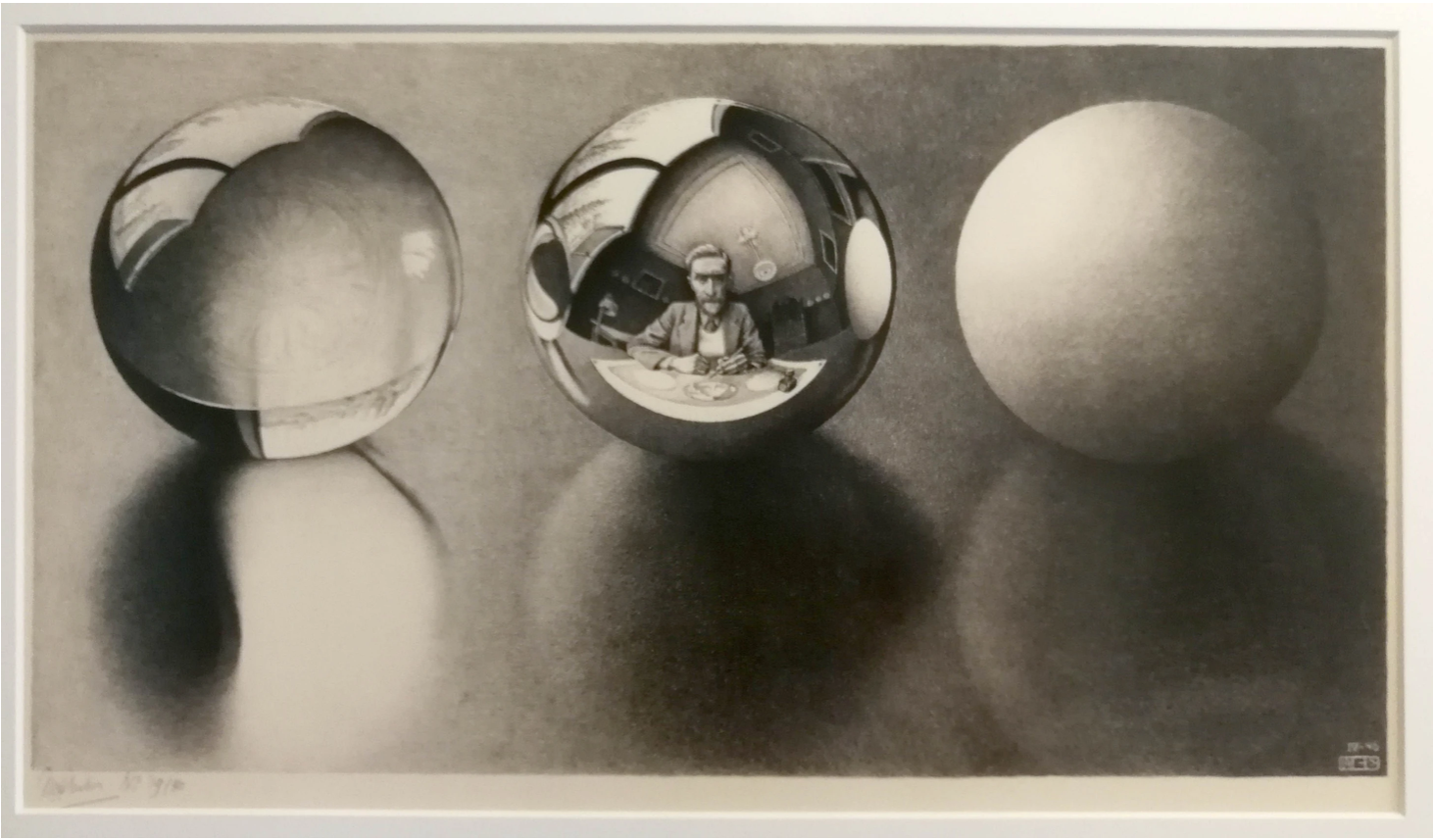
M. C. Escher's Three Spheres II (1946) shows three
spheres resting on a table. They appear identical, yet each
reflects its surroundings differently, one mirrors the room,
another is transparent, the third matte. We chose this image
because it reflects what ASML faced in the late 1990s: three
technological options, EUV, e-beam, and ion-beam, formally equal
on the table, yet each reflecting a fundamentally different
future.
M.C. Escher (1946), Three Spheres II
One Product, One Business Line
To understand why this choice carried such weight for ASML, it
helps to understand how the company was structured at the time. In
the late 1990s, ASML was a young publicly listed company with
essentially one product family and one business line: lithography
machines. From a business perspective, that was unusual.
Conventional wisdom favored diversification, related or unrelated,
as a way to spread risk and protect shareholder value. ASML did
the opposite, because the complexity of its technology demanded
almost monomaniacal focus.
We return in Blog 8 and Chapter 2 to how that focus historically
emerged. For now, what matters is what that focus implied for the
NGL decision: there was no second pillar to fall back on. If ASML
backed the wrong technology, there was no other part of the
business capable of absorbing that mistake.
Looking Through Two Lenses Simultaneously
The chapter describes how ASML approached this choice through two
complementary theoretical lenses.
The first is real options reasoning: behave like a trader in stock
options. Buy time by making small commitments across multiple
alternatives. Scale up only when both technological and economic
evidence indicate that you are moving in the right direction.
The second perspective is scientific reasoning: treat every option
as a hypothesis, make the critical assumptions explicit, and allow
negative results to close off weaker paths.
Individually, both lenses fall short. Buying options alone leads
to delay without necessarily generating new evidence.
Experimentation alone can become expensive and directionless.
Combined, however, they reinforce one another: experiments
generate the information options require, while options logic
determines how deeply to commit to each experiment.
Bringing the Question In-House
One important element explored in Chapter 5, whose implications
may not be immediately visible to everyone, is a management
decision made in 1995. The decision expressed the ambition to
internalize both IP registration and the development of an
in-house research department. Until then, ASML had relied on
Philips NatLab for fundamental research. But an internal research
department was expected to answer the NGL question itself.
The rationale behind that shift was later summarized by the head
of the department, Jos Benschop:
"Do not outsource this question. You can outsource the
activities, but not how do I give an answer to the question. What
will happen after optical lithography?"
The underlying message was clear: activities can be outsourced,
but the foundation of such a strategic question belongs inside the
organization, where the consequences of the answer ultimately
fall. That decision made much of what followed in the chapter
possible. ASML established separate experiments for each
technology considered serious, always in environments where the
strongest expertise was available. There was no early commitment
to EUV; the portfolio deliberately remained broad for years, and
only when evidence accumulated did the center of gravity gradually
shift in that direction. The chapter describes in detail how these
experiments were structured and which dynamics unfolded within
them.
The Same Logic, a Different Outcome
During the same period, Canon Inc. and Nikon applied similar
reasoning. Both developed portfolios of NGL explorations: Canon
through X-ray lithography, nanoimprint from 2001 onward, and EUV
through the Japanese EUVA consortium; Nikon through e-beam, EUV,
and the continued development of optical lithography. Contrary to
what is sometimes assumed, neither company was passive during this
period.
When the financial crisis of 2008 arrived and the costs of EUV
continued to rise, both companies decided to terminate their EUV
programs. ASML's former chief scientist Bill Arnold recalled this
matter-of-factly:
"Nikon and Canon as well, they both had EUV programs at one time
and actually said we can't afford it."
The more interesting question is why the same options logic
produced different outcomes. Part of the answer lies in the firms'
structures themselves. At Canon, for example, lithography
accounted for less than 10% of total revenue; there was a broader
portfolio to fall back on. A diversified company withdrawing from
an expensive technological race makes a reasonable decision within
its own logic. A highly focused company making the same decision
may no longer exist afterward.
Next week: Blog 8 turns to Chapter 2, forty years of ASML in five
acts, including the historical roots of that one-product focus.
Last week, we focused on four audiences: managers in innovative
environments, deep-tech founders, executives of large
organizations, and policymakers, and asked what the patterns
described in this book might mean for each of them. Despite the
discomfort of the limited generalizability of context-specific
patterns,
Susanne
and I still attempted to build that bridge. We
are now past the halfway point and counting down to the
publication date. The coming blogs will move closer to the
substance of ASML itself. We begin, however, at the meta level:
with the semiconductor industry as a whole.
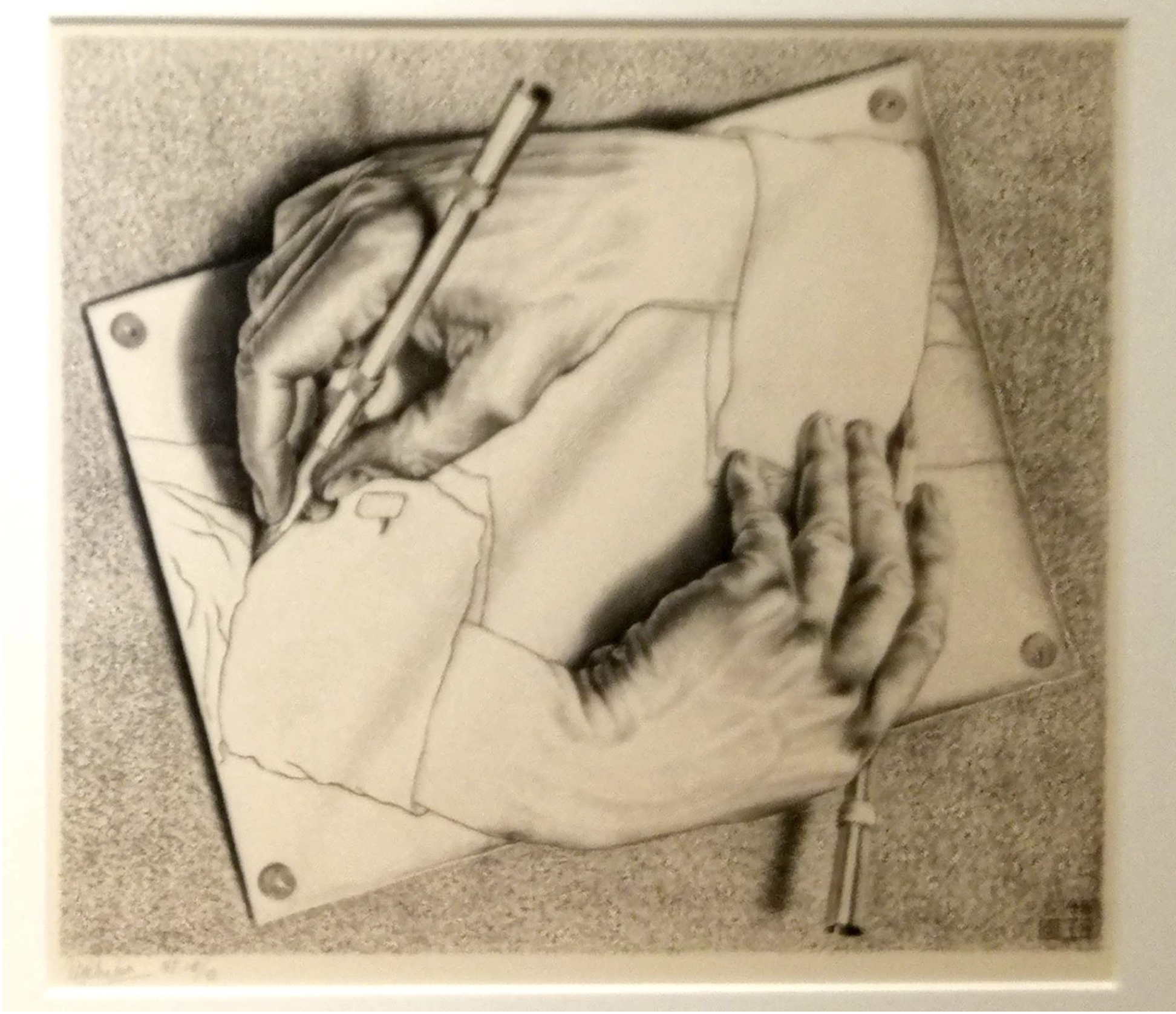
M. C. Escher's Drawing Hands (1948) shows two hands
drawing each other. Neither exists without the other. We chose
this image because it captures what was at play in the
semiconductor industry of the late 1990s: a situation in which
chipmakers, equipment manufacturers, material suppliers, and
research institutions could not independently solve the central
challenge of that period. The problem was too large for any single
player to make meaningful progress alone.
M.C. Escher (1948), Drawing Hands
Collective Uncertainty
Uncertainty is a familiar theme in the literature on strategy and
innovation. But there is a difference between a firm navigating
its own uncertainty and an industry collectively not knowing which
direction to take. In the latter case, not only does the dominant
technology shift, but the entire framework through which the
market is defined becomes unstable. What good enough means is
contested, as is who has the authority to define it.
That was the situation in the semiconductor industry at the end
of the twentieth century. The existing technology of optical
lithography seemed to be approaching its physical limits. The
urgency to find a successor technology was high, yet it was clear
that this would require a collective choice. Any candidate
technology would only succeed if the entire value chain could move
along with it: light sources, masks, materials, and production
equipment all needed to evolve in parallel. Each link had to
develop simultaneously, and no single party could finance or
validate this on its own.
"What 'good enough' means is contested - as is who has the
authority to define it."
The Decision of the Century
Within the industry, this was referred to as The Decision of the
Century. There was significant time pressure: if possible, the
choice of a new technology had to be made before the end of the
twentieth century. The investments required to bring any candidate
technology to production readiness were so substantial in the late
1990s that the industry could not afford to fully pursue multiple
paths in parallel. Only one could ultimately prevail, and the
entire supply chain, masks, materials, and metrology equipment,
needed to align behind that choice.
What emerged was a structured collective process. Every six
months, the champions of all candidate technologies convened. In
the audience were around one hundred experts: chipmakers,
equipment manufacturers, and materials specialists. The different
technology consortia presented their progress to the same room,
and at the end, a vote was taken on which technology appeared
most viable. Those unable to demonstrate sufficient progress lost
votes, attention, and funding. Early voting outcomes moved in a
direction that almost no one had anticipated. In the chapter, we
describe in detail how this process unfolded.
Politics in Its Essential Sense
Participants described this process as technology-driven. And
indeed, the mechanisms were designed as such: comparability,
transparency, discipline, and consortia focused on technological
experimentation. But those who read this chapter may also
recognize something else: the collective and interpersonal
dimension of decision-making.
Hannah Arendt described politics not as governance or lobbying,
but as the space that emerges when people speak and act together:
a shared arena in which individuals appear as distinct actors,
exchange arguments, and initiate something new. Power, in her
sense, is not possessed by individuals; it arises between people
who act together, and exists only as long as that collective
action continues. The binding force of a collective decision, in
this view, does not derive from technical correctness, but from
the fact that people have acted together within that space.
"The binding force of a collective decision does not derive from
technical correctness, but from the fact that people have acted
together within that space."
SEMATECH created precisely such a space. The shared roadmap it
developed and used as a collective guide derived its authority not
primarily from representing the technically correct path, but from
having been shaped collectively by the industry. It emerged in an
arena where no single participant, regardless of size or power,
could fully control the outcome. Socio-economic interests,
geopolitical context, and questions of legitimacy all played a
role alongside technical considerations.
Next week: we zoom in on ASML itself, how the company navigated
that same decision as an individual actor, with its own
technological portfolio and trade-offs.
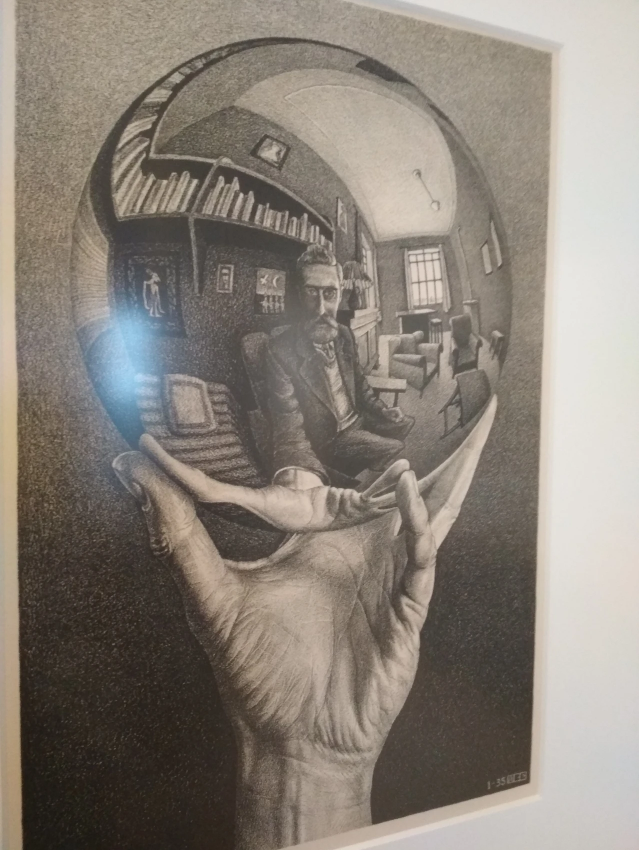
For this blog,
Susanne
and I chose M. C. Escher's
Hand with Reflecting Sphere (1935). He holds up a
reflective sphere and sees himself: the room, the windows, his own
face at the center. What you see depends on where you stand. That
is also the premise of Chapter 9: we reverse the analytical lens -
from ASML to the reader.
For eight chapters, the book has focused on one company: forty
years of choices made under conditions that no one fully
understood at the time. The imprints formed in the early years
continued to shape decision-making long after they were
consciously recognized. Ecosystems emerged through a specific
combination of necessity, institutional legacy, and timing that
cannot be engineered. And strategic options were explored step by
step, refined over time, and, when evidence pointed in a
direction, deepened or abandoned.
M.C. Escher (1935), Hand with Reflecting Sphere
Prompting Dialogue Rather Than Prescribing Answers
In Chapter 9, we take a different approach. We step away from
ASML and carefully connect this material to the reader's context.
Writing this chapter came with hesitation. Throughout the book, we
have aimed to offer observations and questions rather than impose
conclusions: no step-by-step plans, no concrete tips, no synthesis
that replaces the reader's own thinking. We know the context of
ASML, but not that of the reader. And we are acutely aware of how
context-specific strategic decision-making is: what worked in
Veldhoven worked there, under those conditions, with those people,
in that specific sequence of events. As Gjalt Smit notes in the
opening pages of the book: this is not a recipe that can simply be
copied.
"Gjalt Smit already says it in the opening pages of the book:
this is not a recipe that can simply be copied."
At the same time, avoiding any attempt to build a bridge to other
contexts also feels insufficient, a way of stepping aside rather
than enabling broader impact and dialogue. If the lenses we
applied across eight chapters do not connect beyond ASML, why read
them at all? This becomes even more relevant as we increasingly
shift attention from the main title Lessons Learned from
ASML to the subtitle Building and Sustaining
Innovativeness under Uncertainty, a topic that is
particularly timely in the Dutch context. It also resonates with
the current role of Peter Wennink, who now applies lessons from
ASML to the broader economy and calls for decisive innovation and
investment in uncertain times.
Four Audiences, One Story
In an effort to build that bridge, we wrote this chapter with four
audiences in mind: managers in innovative environments, founders
and CEOs of deep-tech start-ups and scale-ups, executives of
established organizations, and policymakers, each with their own
time horizons, degrees of freedom, and blind spots. We link each
group to the theoretical lenses we consider most relevant to their
perspective, without claiming exclusivity.
For managers, the question is how to design an organization in
which unexpected insights have a chance to take root. While
keeping all balls in the air today, you must also create space for
what comes next, fully aware of how rarely those ambitions coexist
without tension. In such a context, how do you build the
conditions for serendipity, rather than missing it because the
agenda is full? And how do you develop routines that allow new
opportunities to move beyond the initial phase and become part of
the organization's collective capability? Within that space, how
do you ensure clarity in choices, roles, interfaces, and the
smooth flow of knowledge and new insights?
We then turn to founders and CEOs of deep-tech companies,
operating in a world where development cycles are typically longer
and riskier than the patience and risk appetite of investors.
Here, we examine strategic options and the scientific approach:
how to stay engaged with multiple possible futures without
assuming the outcome. ASML's long-term investments in parallel
technological trajectories, DUV and EUV side by side, are
informative, but also potentially misleading: they suggest a level
of patience and scale that most founders do not have. For that
reason, the chapter focuses on the underlying mechanisms that also
work at smaller scales.
We then look at the challenge faced by executives in established
organizations: how to make an organization with a rich past
resilient in a turbulent future. This involves not only managing
strategy, KPIs, and market expectations, but also an inherited set
of organizational reflexes, some still valuable, others
experienced as ballast. For them, we explore the role of imprints
and sensitive periods: how to make deeply embedded patterns
visible and assess whether they still serve their original
purpose. And how to use moments of turbulence to deliberately
steer the organization's DNA in a more adaptive direction.
Finally, we turn to policymakers working on innovation and
industrial policy. This is the most politically charged part of
the book, written in the autumn of 2025 in the Netherlands, at a
time when terms such as strategic autonomy and technological
sovereignty dominate public debate. The chapter takes that urgency
seriously and poses a sharp question:
"Peter Wennink has often warned against the dream of becoming a
chokepoint in a supply chain as an end in itself. In his view, it
is healthier to aim for mutual dependencies: being important
enough that others have a stake in your success, but not so
dominant that you turn into a permanent geopolitical pressure
point."
We therefore explore collective action and the geopolitical
dimension of high-tech development: what the semiconductor
industry reveals about organizing shared uncertainty without
undermining competitiveness. And how technological complexity
creates a fine-grained web of interdependencies across global
value chains, while local historical context continues to shape
where regions can truly excel.
What the Chapter Aims to Do
The ambition of this chapter, and of the book as a whole, is to
make patterns recognizable rather than prescribe a path. To raise
questions that help the reader move forward from their own
position, rather than from ours.
"If something here matched an intuition you already had, perhaps
it simply gave it a name. Recognition can be enough for momentum
to form: a shared word, a clearer connection, a decision taken at
the right level."
Whether we succeeded, we will only know when readers tell us.
Next week: collective action to jointly build the individual
competitiveness of the future, on the dynamics of innovation
ecosystems.
April 16, 2026
Three Worlds - Our Own Perspective on Sustainable Innovativeness
Blog 4 of 10 | On the Eighth Chapter of Lessons Learned from ASML
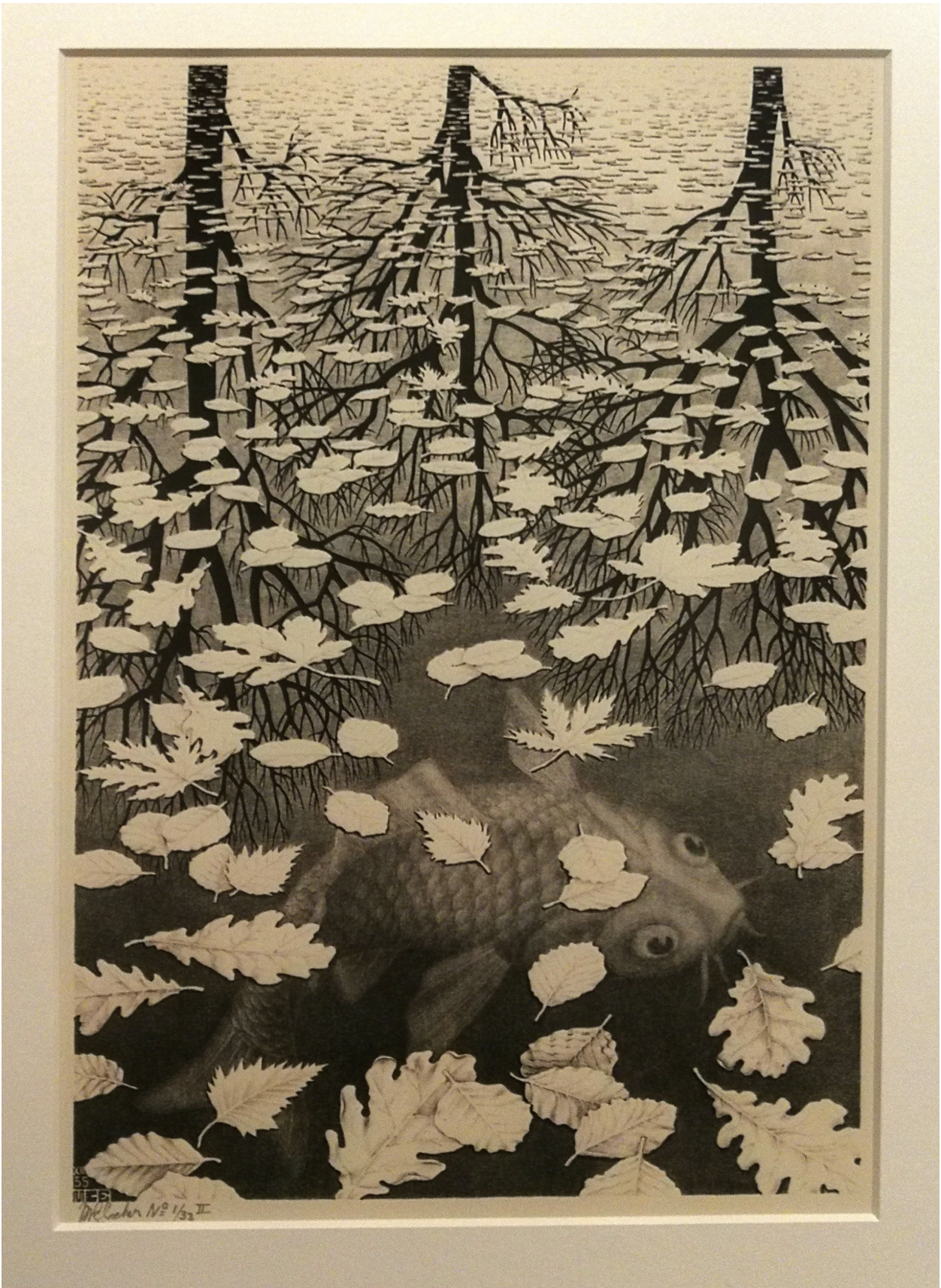
The Escher print we selected for this chapter is
Three Worlds (1955). Three layers are visible
simultaneously on the same water surface: fallen leaves floating,
bare trees reflected, and deep below, a fish that appears both in
the foreground and the background at once. Each of these layers
follows its own logic, yet together they express something none of
them can convey individually. It felt like a fitting image for the
chapter that demanded the most from us to write.
In the seven chapters before this, Susanne and I could
comfortably stay behind empirical data, theory, or a combination
of both. Here, that is no longer possible. This chapter is
personal: two people who, after years of research and practice,
offer their own take-away or modest perspective, fully aware that
entire libraries exist on the themes we touch upon. Whether it
succeeds is left to the reader.
M.C. Escher's Three Worlds (1955), different
perspectives that together form a system, each with its own logic.
Why We Did It Anyway
We do not know how many management books we will write in our
lives. It is quite possible that this, alongside all our other
activities, will be our most ambitious one, simply because
spending another fifteen years on something similar seems
unlikely. With that realization came a conviction: if you tell
this story, and you also have something to say about how you
think, then this is the moment. Opportunities like this rarely
come twice.
So yes, the combination of perspectives in this chapter is truly
our own construct. That makes it all the more exciting to share,
especially because we try to do so as fully and concisely as
possible, while each perspective contains an entire world behind
it. The spectrum we cover is broad: from the highly rational and
systematic to the almost intangible. This is intentional because
innovation under uncertainty requires both, even if they are
difficult to articulate simultaneously.
The motivation behind this chapter extends beyond ASML. We would
like to see more organizations develop the decisiveness and
learning capacity that ASML has built. At the same time, we see
that the reality in many organizations is far removed from how
ASML operates. Embedding such innovative capacity more deeply
begins with an integrated view of the organization itself: the
futures it envisions, the assumptions underlying those futures,
and what is actually required to realize them. We wrote this as
an invitation to examine one's own situation through multiple
lenses at once, without resorting to ready-made formulas.
Two Perspectives, One Question
The question that occupies both of us is how to formulate a
strategy that provides direction yet remains adaptable in an
uncertain context, and how to translate that into practice in
organizations made up of real people, each with their own views,
fears, interests, commitments, and insights. How do you create
something that works at the level of the organization, the groups
within it, and the individual?
One perspective approaches this question through three
instruments, applied as an integrated learning cycle: scenario
planning to keep multiple plausible futures alive,
Discovery-Driven Planning to make underlying assumptions explicit
and testable, and scientific experimentation to actively test
those assumptions while uncertainty is still unresolved. Together,
they describe a way of working he calls disciplined readiness:
preparing, screening futures, and delaying commitment until a
choice becomes necessary and confidence has grown sufficiently to
make it.
"It is simple; you eat an elephant in small pieces. So there was
a program which always had a horizon of a couple of years ahead.
And then there was a deliverable or an intended deliverable that
never came because we found a hurdle that we could not jump. And
then you have a new two-year program ahead."
- Erik Loopstra, ASML Fellow
That pattern, defining possible horizons, testing them, hitting a
wall, and starting again, is what innovative strategy looks like
in practice. Far less linear than it appears in a book, as we
know all too well.
Susanne's perspective starts from a different but related
question: how does strategic intent travel through an
organization? How do you anchor a sound plan in a complex
reality? She works with three intertwined layers, each with its
own systemic perspective.
The systems engineering layer asks what the whole must deliver,
how to structure it, and where the explicit trade-offs lie. The
systems dynamics layer asks which flows and feedback loops
determine whether the organization responds to change in a
learning-oriented way, and how intended loops relate to everyday
behavior. And then there is the systemic layer of the human
undercurrent: the less visible domain of connection, order, and
balance, the fears, loyalties, and status dynamics that can
reinforce or quietly undermine formal structures.
That third layer is often considered soft, yet it is precisely
what explains why two organizations with very similar strategies
and structures can perform so differently. You may choose not to
devote time and attention to it, but it develops regardless and
affects an organization's capacity and innovativeness.
"The hope is simple: that these pages help bring strategy,
scenarios, structure, flows, and undercurrents into the same
line, so that innovativeness travels beyond pitches, post-its,
pilots, and PowerPoint and into how work is done."
That is the promise this chapter seeks to deliver, fully aware
that it may come across as complex. Sustainable innovativeness
only emerges when it becomes an integral part of the organization,
and its development therefore requires a systematic approach. With
this chapter, we aim to offer a clearer view of how that bridges
strategic ambition and organizational reality.
Next week: What does all of this actually mean if you are the one
making the decisions?
April 8, 2026
Belvedere - The Patterns You Only See When You Rise Above the Story
Blog 3 of 10 | On the Seventh Chapter of Lessons Learned from ASML
ASML is an exceptionally specific company. The technology, the
sector, the scale, the geopolitical position - few industries in
the world lend themselves to easy comparison. And yet, we are
writing a book that aims to offer lessons that extend beyond
Veldhoven. How do you do that without losing specificity, or
diluting the insights into platitudes?
That is the question this chapter addresses directly. Our
approach is to zoom out - to move one level higher and survey the
terrain before making claims about what can be learned.
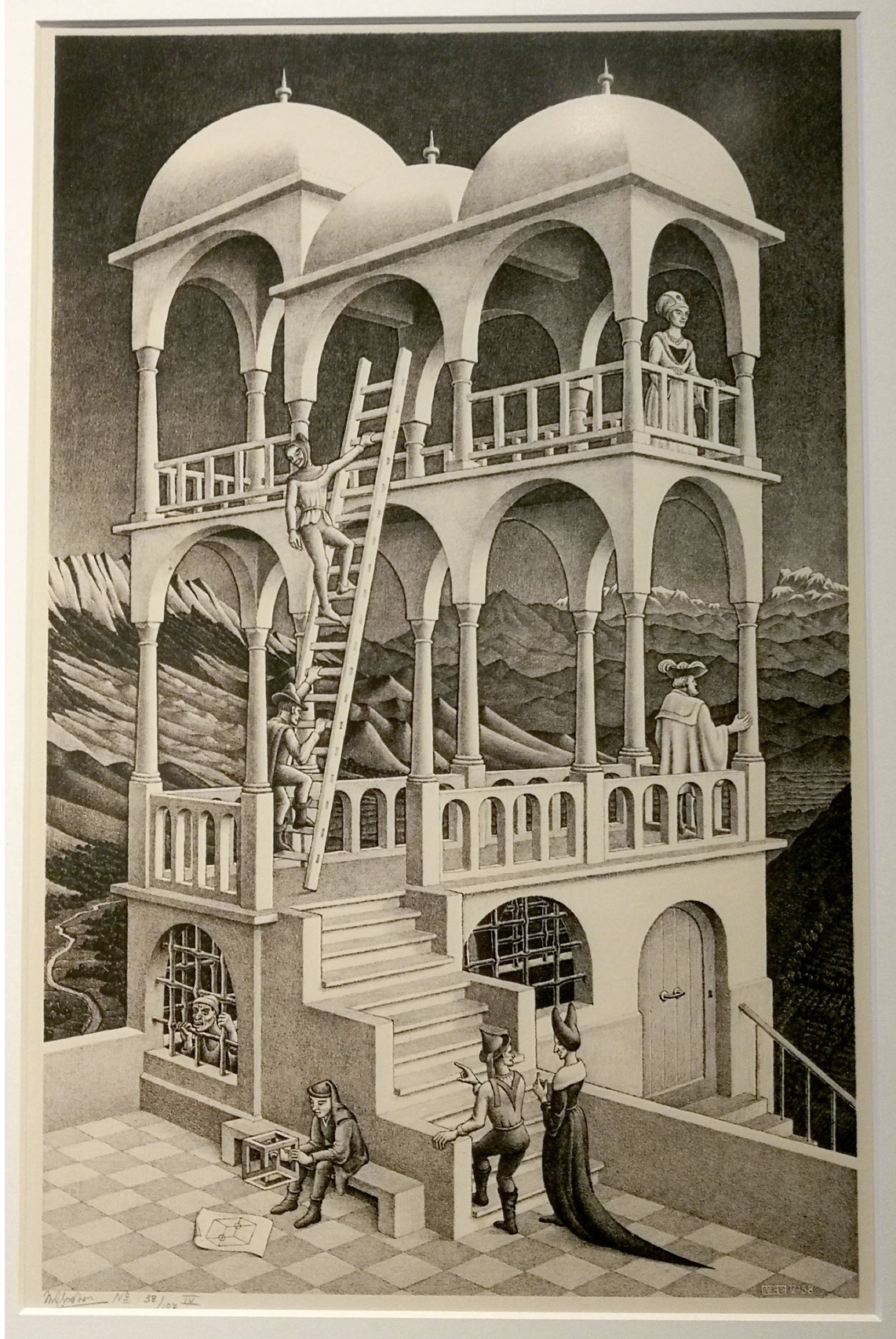
The Escher print for this blog is Belvedere (1958). A
figure climbs to the upper gallery of an architecturally
impossible building to overlook the landscape. At each level, the
construction holds; only the whole refuses to make sense.
How do you learn from such a story? By stepping above the story
itself, making visible patterns that remain hidden at ground
level, while staying explicit about the limits of what can be seen
from any given vantage point. Every theoretical lens has its value
- but combining too many risks obscuring rather than clarifying.
M.C. Escher's Belvedere (1958), a more far-reaching
perspective from a higher vantage point.
The Danger of Looking Back
Martin van den Brink, former CTO and Co-President of ASML, puts it
bluntly:
"What we said to have as a strategy in the first ten years is that
we are going to be light... At the time, it was no strategy at
all; you had no money and no capability. So the only thing we
could do was to go to suppliers... There is a completely different
dynamic in a time in which you developed a strategy than when you
start looking back."
This is precisely the pitfall the chapter seeks to avoid.
Retrospective accounts of success tend to produce coherent
narratives. But the patterns that truly mattered rarely resemble
the patterns that, in hindsight, appear deliberately chosen.
Theoretical lenses help make underlying mechanisms visible - not
to construct better stories about the past, but to understand
which structures are transferable beyond ASML, and where that
transfer breaks down. That is the objective of this chapter: not
to retell the story, but to surface the mechanisms beneath it and
specify the conditions under which they apply elsewhere.
Multiple Axes, Simultaneously
The chapter approaches the ASML story along multiple axes. No
single perspective captures the whole; each highlights a
different dimension.
One axis runs from the individual to the ecosystem. Some patterns
are visible at the organizational level - how early choices about
structure and supplier relationships persist over decades, how
crises are converted into learning moments. Others only emerge
when zooming out: how industries organize shared uncertainty, and
how competitors collaborate to stabilize the playing field without
relinquishing strategic autonomy. These levels are interdependent
- what an organization can do depends on what the ecosystem
allows, and vice versa.
A second axis runs from past to future. Early choices leave
imprints that extend beyond deliberate strategy and are difficult
to reverse. Yet moments of revision do occur - typically during
crises, technological discontinuities, or leadership transitions.
These are sensitive periods, when what once appeared fixed becomes
temporarily fluid. Understanding the past is therefore not a
historical exercise, but a strategic capability for shaping the
future.
A third axis concerns uncertainty itself. There is the fog of
technological ferment - when multiple paths appear plausible and
established decision anchors lose their grip. There is the
uncertainty of interdependence. And there is the uncertainty of
chance, discussed in the previous blog. Each requires a different
response; conflating them is costly.
Finally, there is the relationship between change and stability.
How do you incorporate evolving insight while maintaining a
direction that remains actionable? The chapter does not offer a
formula, but it does offer a way of seeing - and that distinction
matters.
A Picture Says More Than 1,000 Words
"The value lies in what a good lens always offers: a way of seeing
that can be tested, adapted, or set aside with reasons."
This is the chapter with the figures. Conceptual models that
condense patterns that would otherwise require pages of prose. No
self-respecting management book avoids presenting an
all-explaining matrix - so we have included one as well.
At the same time, the figures provide structure for each
theoretical lens: which elements matter, and how they relate. The
lenses are related, but combining too many at once blurs the view
and makes it harder to identify what is essential.
You will find these figures in the book - where they can be read
in the context of the narrative that precedes them.
What Can Be Carried Over?
Returning to the initial question: how do you learn from a story
that resists comparison? Looking only for similarities is
insufficient. More productive is to isolate mechanisms that
operate beyond the specific context - and to clearly define where
analogy no longer holds.
"The ASML story functions as a magnifying glass, not a mirror."
It does not show what your organization looks like; it clarifies
which questions are worth asking. From the Belvedere, you see
further.
Next week: a look into the chapter we found most challenging to
write - on strategy, systems, and the things that can only be
sensed.
April 1, 2026
Relativity - On the Role of Chance, Where You Start, and Who You Meet Along the Way
Blog 2 of 10 | On the Sixth Chapter of Lessons Learned from ASML
Last week, we concluded that ASML's trajectory can be well
explained in hindsight, but its success was not as inevitable as
we might now assume. That gap between explanatory logic and the
reality of how things actually unfolded is what this chapter
explores further. Where many management books explain how good
management and leadership contribute to organizational success,
here we explain success through factors that lie largely outside
ASML's sphere of influence.
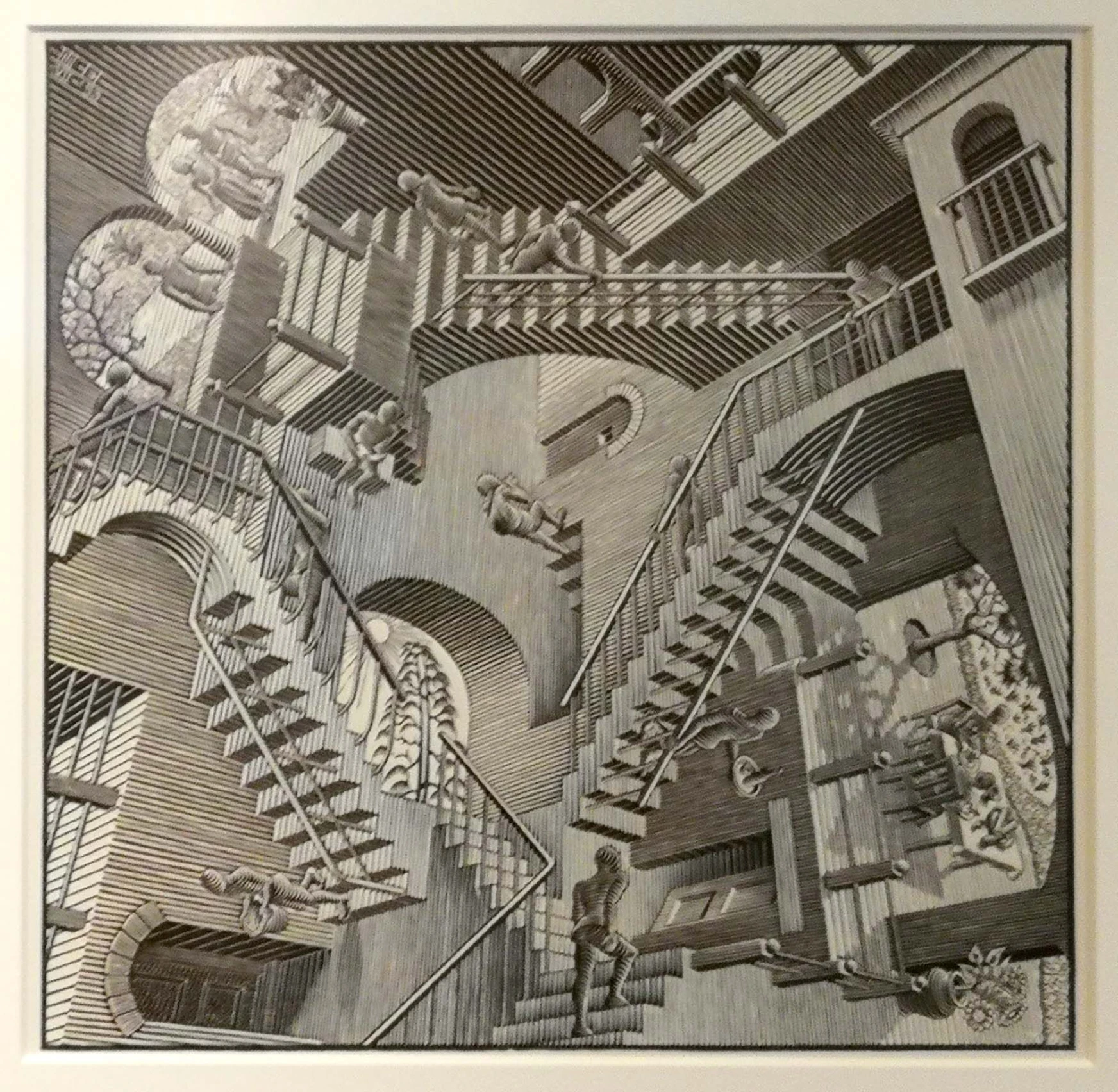
The Escher print we selected for this blog is Relativity
(1953). Figures move through the same architecture, but each
within their own gravitational field. They cross the same
staircases, pass the same arches, yet perceive the space entirely
differently. Who you are and where you start determine which route
you see, but they also determine who you encounter, what
coincides, and which connections emerge that no one had
anticipated. This image fits the questions we raise in this
chapter.
"Who you are and where you start determine which route you see;
but it also determines who you encounter, what happens to
coincide, and which connections emerge that no one had
anticipated."
The Unpublished Manuscript of Chance and Necessity
Gjalt Smit, ASML's first CEO, wrote a manuscript after his tenure
about the early years of the company that was never published. He
titled it Chance and Necessity, after the work of
biologist and Nobel Prize winner Jacques Monod. Monod argued that
random, unplanned events lie at the basis of every breakthrough,
and that necessity - the structured response to those events -
turns them into something enduring. Smit recognized that pattern
in what he himself had experienced. The major unexpected turns in
ASML's early years he described as "acts of God." Not to
downplay his own role, but because he knew that several of the
major plot twists lay far outside his sphere of influence.
The role of chance, luck, and serendipity is increasingly taken
seriously in the management literature as an explanatory factor
for strategic success, although practice, as usual, has been ahead
of theory for much longer. The tendency to retrospectively
construct a strategy that neatly explains why something worked
remains persistent. Anyone who looks closely at the history of
organizations that have achieved something extraordinary sees that
luck and misfortune play a more substantial role than we usually
acknowledge. We do not present it as the sole explanation for
success or as an excuse for failure, but as a factor that deserves
to be taken just as seriously as the quality of management and
leadership.
"The major unexpected turns in ASML's early years he described as
'acts of God.' Not to downplay his own role, but because he knew
that several of the major plot twists lay far outside his sphere
of influence."
Three Concepts That Describe Fundamentally Different Things
Chance is the unexpected event itself - it is neither intended nor
designed. Luck, or misfortune, is how that event falls on you,
which depends on where you stand at that moment and what you have
already built. Serendipity is the third concept, and the most
useful in practice: the ability to recognize the unexpected and
make something of it, because you were prepared to see what there
was to see. Three closely related concepts that are often lumped
together under the umbrella of coincidence or luck, but that
describe fundamentally different things. And that each require a
different managerial response.
The Map That Shapes the Playing Field
One of the most striking passages in this chapter is not about
internal decisions, but about the geopolitical constellation in
which ASML was able to grow. Not the recent discussions about
export restrictions and EUV - those are the subject of other books
- but the slower, less visible structures that had already drawn
the map long before ASML had sold even a single machine.
ASML began in a world in which tensions between the United States
and Japan over trade policy and market share in the semiconductor
industry were decisive. Who you were, and where you came from in
that field of forces - trusted or suspect, neutral or politically
burdened - determined which paths were accessible and who had an
interest in working with you. A relatively small Dutch company,
far from the centers of power, turned out in that context to be an
unexpectedly useful partner for organizations seeking a
non-Japanese alternative, or those preferring to work with someone
outside the trade-policy frontlines. No one in Veldhoven had
influence over how that context had come into being. But the map
was already there, and who you met along the way - and which doors
opened - was partly determined by it.
From Coincidence to Structural Response
Using a number of concrete ASML episodes - which we will not
reveal here, but which range from a travel ban during the Gulf War
that nearly cost a critical contract, to a forgotten design choice
that years later turned out to be the key to a major technological
advantage - we show how random circumstances were turned into
durable strengths.
But the chapter does not stop there. The central question is not
only what happened by chance, but how ASML as an organization was
structured to make something of that chance. What the episodes
have in common is a structural response: an organization that was
lightly built, modular in design, and that shared information
quickly across internal and external boundaries. This made it
possible to absorb the unexpected and act on it before the window
closed. These organizational characteristics turned out to
determine whether a random event remained a risk or became a
springboard.
"Chance throws the dice. But Necessity - the structured, prepared
response - determines what is made of the outcome."
Next week: how we use theoretical lenses to lift the ASML story
beyond the boundaries of a single firm - and in doing so sharpen
your own perspective on innovation under uncertain conditions.
March 26, 2026
Waterfall - The Impossible as a Point of Departure
Blog 1 of 10 | On the First Chapter of Lessons Learned from ASML
Each blog previews a chapter. We pair the series with lithographs
by M. C. Escher - a deliberate choice. Escher worked in
lithography, the same printmaking technique that underpins the
semiconductor chips on which the digital world runs. More
importantly, his work invites a way of seeing we aim to cultivate
in this book: holding multiple layers at once and staying with the
tension between local logic and the seemingly impossible whole
that ASML represents.
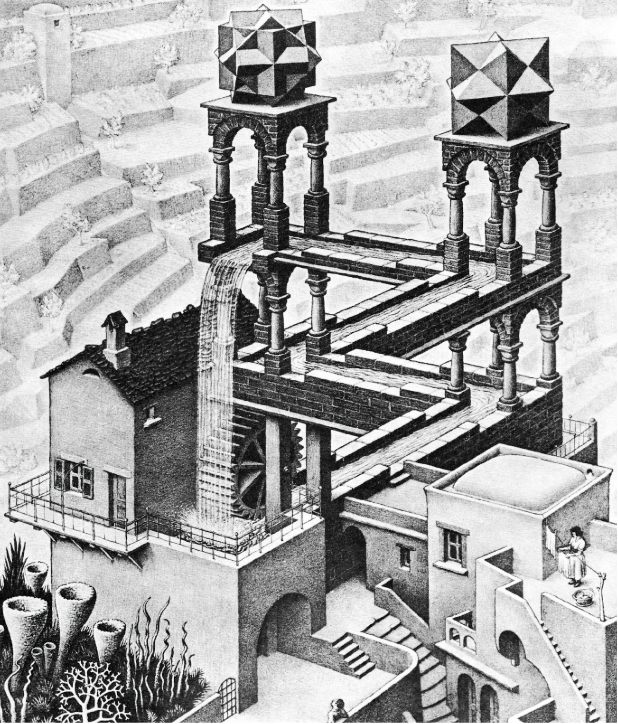
This week's lithograph, Waterfall (1961), shows water
flowing toward a mill, falling downward, and then somehow rising
again on the other side of the aqueduct to begin the cycle anew.
Escher built it from three Penrose triangles, each individually
geometrically correct, together forming a closed loop that cannot
exist in three dimensions. The image stays with us because we
recognize something in it about how people engage with the
impossible: mathematical precision in service of human
imagination. That interplay is also key to the story this book
tells about ASML.
"Making the impossible possible was a recurring maxim within ASML."
Technology as the Carrier of the Story
EUV lithography - the technology with which ASML today helps
produce the world's most advanced chips - uses light of 13.5
nanometers, guided via mirrors with a maximum deviation of less
than 0.02 nanometers. To put that in perspective: if you scaled
that mirror surface up to the size of the Dutch province of
Brabant, the largest imperfection across the entire surface would
be a ten-centimeter sidewalk bump.
At ASML, technological progress is not just a means to a
commercial end; it effectively becomes the organizing principle of
the firm. Building the next machine, reaching the next wavelength,
and enabling the next generation so that customers can keep
improving their own processes - that is the organization's deepest
drive, and it has never fundamentally changed. Which is precisely
why it is so instructive to understand how that technological
foundation was laid and sustained: under turbulent conditions, as
markets collapsed, shareholders doubted, and competitors made
different choices. Behind every technological plateau are people
who chose a direction at decisive moments, entered into
collaborations, and persisted when doing so was, rationally
speaking, far from obviously the right call. The mechanisms behind
those decisions and that commitment are what this book seeks to
illuminate.
That deeper inquiry is why we wrote this book. ASML's success is
already well documented; what we sought to understand is how
innovative capacity is built and sustained when uncertainty is not
temporary, but persistent. ASML started on 1 April 1984 with 47
employees in wooden barracks on the Philips campus in Eindhoven,
last in a field of seven competitors. Customers were skeptical,
the parent company doubted, and the market collapsed in the very
first year. The choices made in that period accumulated over four
decades into something that, in retrospect, looks inevitable - but
never was.
We spent more than ten years on this research, in archives and in
conversations with dozens of people inside and outside ASML,
repeatedly holding those insights up against what the management
sciences have to say on comparable questions. The guiding
principle throughout was the same: when the data contradicted the
tidy story, the story had to change.
"We wrote this book to make it more broadly accessible how
innovative capacity is built and sustained when uncertainty is not
a temporary condition but a permanent one."
What You Will Find in the First Chapter
The first chapter establishes the terrain before the story begins.
A few things readers will encounter:
A concise guide to lithography, written in part from the expertise
of Martin van den Brink, former CTO and Co-President of ASML and
the technological architect behind the EUV breakthrough. Together
with us, he explains - without assuming the reader is at home in
optical physics - why reducing the images projected onto
customers' wafers as precisely as possible is at the core of
everything ASML does, and what that demands of engineering. It is
the technical context needed to follow the strategic choices
examined in the chapters that follow.
That is followed by a first exploration of something paradoxical
within ASML: despite being the de facto sole supplier of the
world's most advanced lithography machines, the word
'monopolist' is forbidden internally - not as a symbolic gesture,
but as a genuine conviction. Being the only supplier in an
interdependent supply chain does not automatically confer greater
power; customers ultimately determine what needs to be done, and
any form of complacency carries existential risk. That posture -
treating dominance as fragility - calls for explanation, and this
chapter provides it.
Finally, we sketch a picture of just how volatile the
semiconductor market truly is. On average, the sector lost more
than a fifth of its revenues in each downturn cycle over the past
forty years, sometimes within the space of months. For a company
that is fully operational and must swing rapidly between steep
scale-ups and sharp downturns - while simultaneously keeping
high-risk, long-horizon R&D programs running - this creates a
permanent tension between technological ambition, financial
manageability, and organizational flexibility. Understanding what
that tension looks like is a precondition for appreciating the
choices examined throughout the rest of the book.
Next week: the role of chance, luck, and contingency as
explanatory factors in sustained innovation and success.